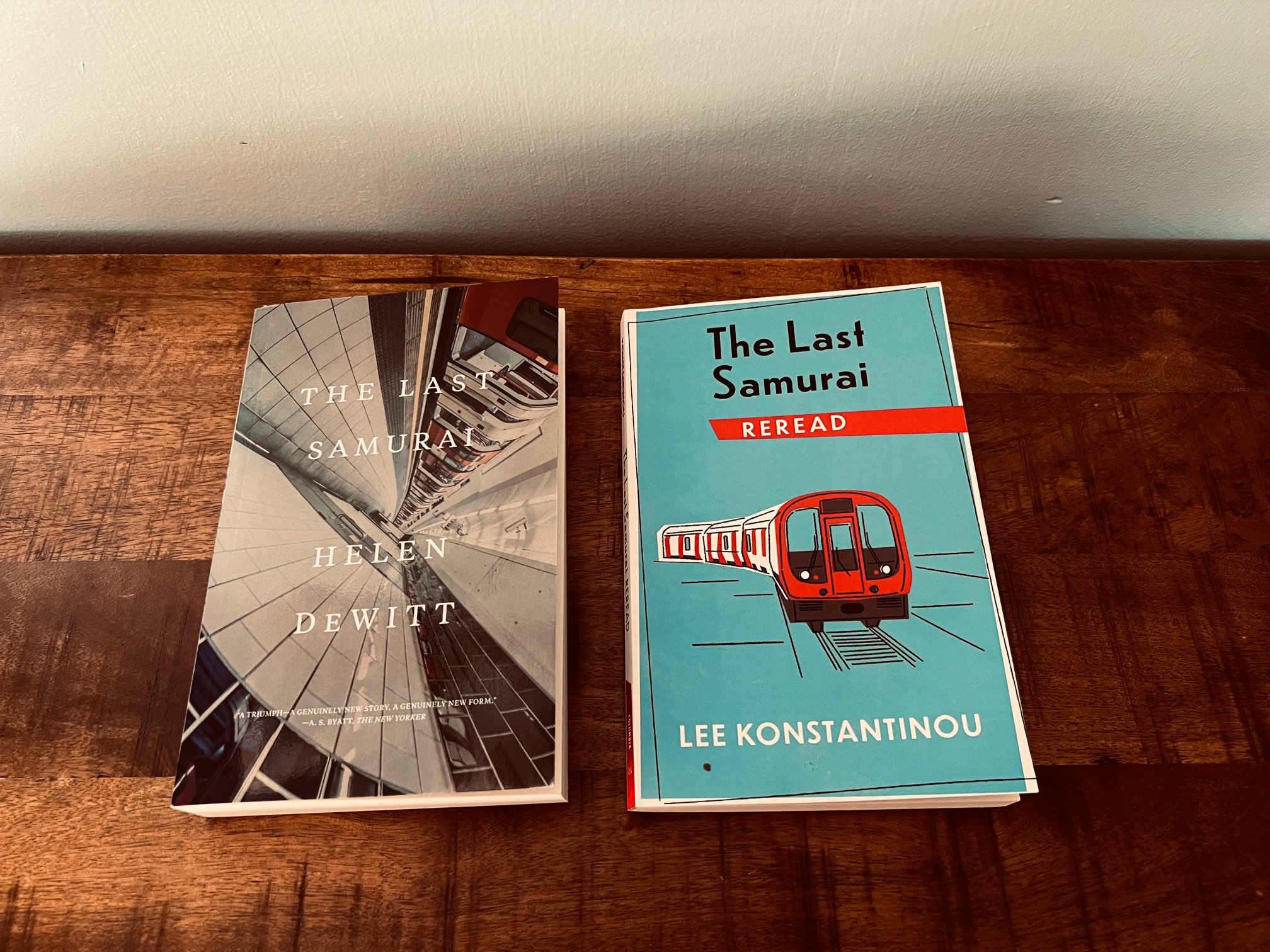
For me, this is a genre of book to be treasured. One sharp critic reads one novel and its context. Columbia University Press has created an entire series called Rereadings (you can find the link to the series here), which over the last two years has featured short books by critics and scholars about such novels as Vineland, The Savage Detectives, and A Visit from the Goon Squad. I have just finished the most recent book in the series, Lee Konstantinou’s The Last Samurai Reread, and I believe Helen DeWitt’s great novel has received a much-needed strong and comprehensive reading. If you are a fan of DeWitt’s novel, as I am, you should read this book.
If you have not read The Last Samurai, that’s the first thing you should do. In fact, in his fifth endnote to his Preface, that’s exactly what Konstantinou advises.
5. If you haven’t read the novel, stop what you’re doing and go read it right now. Don’t worry—this book will still be here when you finish. Even though the novel is over five hundred pages long, it’s a surprisingly fast read. If you’re still here and still haven’t read the novel, well, okay… you’re more than welcome to keep reading. I’ve tried to make this book accessible even to those who haven’t yet read the novel.
Amusing, but I think it’s true. It’s obvious you’ll get more out of the entire Rereadings series by having read the books in question first, but Konstantinou does what he says he does. His style is engaging and accessible. It’s witty, too. The description of our current mediasphere as “littered with luminescent turds” made me laugh aloud and think of certain turns of phrase in DeWitt’s fiction. From this book, you can expect to learn about such things as Helen DeWitt’s PhD dissertation, DeWitt’s feelings on the purpose of worthwhile art, how hard it is for a contemporary artist to produce such a thing as a highly regarded and formally inventive novel, how this novel came to be written, shopped to agents, copy edited and finally published (all stages in the life of this novel that were fraught for DeWitt) and what the dynamics of the power relations between a publisher and an author are like.
Konstantinou gathers the details for this life of The Last Samurai from statements Helen DeWitt has made in the more than 20 years since publication. These come from her personal blog, several interviews with reviewers and critics, and Konstantinou’s own interviews with Helen DeWitt. It’s enlightening and comprehensive and done with a purpose. Late in the book, Konstantinou writes, “A sociologically minded critic cannot assess a text without knowing the institutional contexts of its production and the power relations that shape those contexts.” This is a claim I find irresistibly true, and The Last Samurai is the perfect object example for it.
I’m also compelled by Konstantinou’s allegorical reading of The Last Samurai, which he pieces together throughout his book, but which might be best pointed to in the passage below.
Ludo’s quest to find an aesthetic form of life, which is also a moral form of life, recapitulates DeWitt’s quest to find a workable form for her book. The Last Samurai is neither, as [editor] Jonathan Burnham thought, the story of a mother’s love for her son nor, as DeWitt claimed, about what a mother must sacrifice for her son; it is a fantasy that your child (here a figure for your own novel) might outlive you, might achieve its own autonomy, might gain widespread popularity without compromising rigor, and might even, in some sense, save you, despite its misbegotten corporate parentage.
The Last Samurai needs more readers, and it needs more readings like this one. Fortunately, the edition published by New Directions in 2016 is widely available. The Last Samurai Reread is scheduled to be released by Columbia University Press in November 2022. Please find the link to the book’s page here.


 Talking Big
Leave a comment