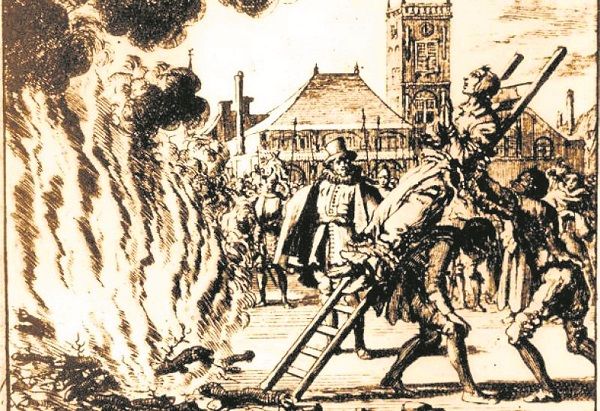
By Jay Innis Murray
For a certain man tells that, when he had lost his member, he approached a known witch to ask her to restore it to him. She told the afflicted man to climb a certain tree, and that he might take which he liked out of the nest in which there were several members. And when he tried to take a big one, the witch said: You must not take that one; adding, because it belongs to a parish priest.
— Malleus Maleficarum, 1486.
Though it is short, The Wax Child is impressively packed with kinds of texts. First, it is that rare and beautiful thing: a poet’s novel. It is a deeply-researched historical speculation. It contains spells and recipes for enchantments and remedies. It employs a remarkable narrative device to let speak the women (the accused) whose voices largely do not appear in the records of the Danish witch trials of the years 1595 to 1621. It gives life to a wax doll. This book moves with light feet despite the heavy matters. It blew me away. No surprise, then, it has been longlisted for the 2026 International Booker Prize. The translation is by Martin Aitken. It was published last year by New Directions here in the United States.
The novel opens with the wax child speaking of itself. This gives the reader an immediate sense of the situation of the novel. There is magic in this world, and some of that magic aims with bad intent. Here is the opening.
I am a child shaped in beeswax. I am made like a doll the size of a human forearm. They have given me hair and fingernail pairings from the person who is to suffer. I was borne by my mistress for forty weeks under her right arm as if I was a proper child, and my wax was softened by her warmth… I am an image, in the absence of a child. I have this bottomless, shaft-like longing for the woman who made me, whose name was Christenze Kruckow.
We’re introduced here to the book’s direct tone, a style that reminds me of John Donne (“A Nocturnal Upon St. Lucy’s Day”), and a number of questions. Why must a person suffer? Why is the child longing? Who is Christenze? The answers to these questions are the novel.
Christenze Kruckow was a historical figure from the history of the witch trials in Denmark. She created the wax doll and, by witchcraft (“She loosens the figure from the mold. The figure is me. She whispers certain things into my ear.” p 17), gave it a mind and a voice. The child is a sort of receiver, sensitive to the talk, activities, and thinking of the humans around it. The child can also connect with other objects in the world and with animals to give a long reach to its narration. For example, the child is able to get inside Denmark’s king, Christian IV, as he works in his palace miles away.
And I was in the king’s ear, and I was in the king’s mouth, and I was in the king’s loose tooth and in the quicksilver of his liver, and did hear. A scratching of the pen across the paper as he wrote a royal letter to his deputy… (Page 55).
This mysterious power is never exactly explained, but it is as if the camaraderie with Nature (maybe it’s something quantum, beats me) of Christenze and the other witches extends to the child and gives the child access to everything. Though it has no mouth, the child likes to talk. If it is not omniscient, it is something close. If it is not exactly everything, it is enough.
I have not yet mentioned the problem of the novel. From early on, Christenze is suspected of being a witch. As it is said, a rumor of witchcraft follows her. At the opening of the novel, she lives as a lady’s companion in the household of a woman named Anne Bille. The wax child explains, “Before Anne was thirty-two she had given birth to and lost fifteen infants.” Christenze at this time is thirty-six. She is of noble birth. She is unwed, uninterested in men, and independent in all ways except financially. Anne looks at her and blames her for the deaths of the infants. “… and Anne scowled then at this ruddy-cheeked, unwed noblewoman and hissed between her teeth: You, ‘tis you, you are a witch.”
Ousse, a kitchen maid in the household, is also accused and is burned as a witch. Christenze flees the area and ends up in Aalborg. There, she meets other women like her. These include Maren Kneppis, Apelone Ibsdatter, and Dorte Kjærulf. These are real, historical women Ravn researched, women, like Christenze, who were accused and tried for witchcraft. Some of the most wonderful chapters in the book (most of which are just a page or two) are descriptions of the women together in wonderful solidarity. Often, they are working at a task together, many hands making the work lighter, talking and chattering and joking with each other.
For example, there is an early scene of women carding wool.
The preparation of the wool began at the equinox. The carding fests were always in the eventide. There were many women in the town, many girls, and with my mistress I accompanied them through the streets, since one evening they would gather at one place, the next at another, and help each other card the wool. First they would eat waffles and drink mead, then when midnight came a roast would be served, and sweet soup with sago and fruit syrup, and also dried cod. After that they would card again until two or three in the night, depending on how much fleece they had. On the floor between them was a selde, a flat wicker basket, that was filled with wool. The oldest among them, who were most practiced in the art, would take a clump and separate it. Canny-eyed, they would hand out a tuft to each of the others, and were so proficient there would always be just enough for everyone, in equal amount. Then they would contest and the one who finished first would be the ablest. And Christenze would sit in their midst and compete with them whilst the widest grin was on her face, although she always came last… (Page 35)
There are other more intimate and sensual scenes, especially involving Maren. The meeting of Maren and Christenze pushes Ravn’s prose to a higher, more figurative register.
And then one day, on the street called Algade, Christenze met Maren. Maren, who, Christenze at once discerned, gleamed with a light that was golden, as though she were part deity, part effervescent ale, and men flocked about her and her long hair, and she laughed at them, and Maren Christenze sensed a distant region. When they clasped hands in greeting, Maren without hesitation hooked her arm under Christenze’s and said, Let me show you around, you’re new in town, and they looked into each other’s eyes and Christenze there recognized in Maren what neither of them had words for, but which Christenze saw to be a marshaled or a hidden room, and Christenze’s lips then almost sprang from her face, so badly they wanted to get to Maren’s. And secretly Christenze sniffed in Maren’s smell and the smell of Maren’s hair and Maren’s breath, it smelled of milk and salted meat and hay. (Page 30).
That effervescent ale phrase is wonderful. We’re in speculative territory here. Maren was married to a man and had a child. Neither woman kept a diary that has survived. In a novel, of course, historical speculation has long been in a writer’s toolbox. The wax child watches all. In fact, the child is often passed to Maren and to her daughter, Karen. The child is sometimes buried under ground to be safely hidden from the wrong, spying eyes. The child even rides a cat in one short scene. “… and together we scurried through the garden across to Elizabeth and Klyne’s house…” (Page 48). This name, Klyne, makes my skin crawl as I type it. Klyne is a problem for the women in Christenze and Maren’s circle. He is the pastor of the church in Aalborg. Early in the book, his wife Elizabeth is a friend, a member of the circle. The women comfort and support her when he abuses her. For this reason, this solidarity, more than any supernatural harm they can inflict, is a threat to Klyne, every power he represents, including the king’s.
The last hundred pages of the novel are a section titled: A Witch Trial. This section is written with such a command of the material that it opens a door for the reader to Denmark in 1621. Ravn writes of the interior of the prison where the women are kept, their conversations, scenes of the various trials, what the monetary costs of the trials were, and how the population of Aalborg was divided on the appropriate punishment for the women. Christian IV like his brother-in-law James I of England (of Shakespeare’s Macbeth fame) became obsessed with witches. He is presented with glimpses by the wide-ranging eye of the wax child and in one tour de force of a chapter late in the book in which Christenze is taken to the palace in Copenhagen, thinking she can take advantage of her noble birth and a comic, disarming audience with the king to get herself free. The reversal in the outcome is sad and bitter. The reader sees it coming, but Christenze does not. The book then races to its inevitable ending.
There’s a wonderful podcast episode of Between the Covers on which David Naimon interviews Olga Ravn, and she talks more about the history of these times and the work of her research that led to the novel. Here is a link. I recommend a listen.
There’s magic in a speculative, historical novel, one of my favorite genres when it is done right by a gifted writer. These books help us to know the world better. The wax child said it best in fact. How do I know all this? Because the fish told me. The blossom told me. The threads of the tapestry wailed and turned to whisper it.

 Talking Big
Leave a comment