By Jay Innis Murray
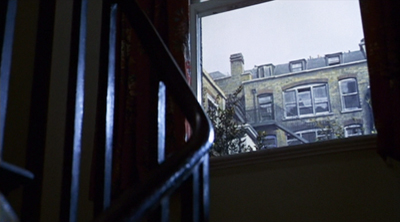
As I think about works that are similar to Glantz, the troublingly great novella by Tobias Ryan, some novels by Saramago come to mind, but the itch I cannot scratch away is the script from Alfred Hitchcock’s Frenzy, a film about bars and apartment buildings and killers walking around in neckties. If you’ve seen the movie, you’ll know the famous scene (David Bordwell calls it florid) in which the murderer Bob Rusk lures Babs, his mate’s girlfriend, to his own apartment. Hitchcock’s camera follows the pair as far as the door, and after Rusk and Babs enter the apartment, Rusk closes the door behind them, and the camera backs slowly away from the horror of what we know is happening in the apartment. Here is a link to the scene: https://tinyurl.com/cewea4xx
In Anthony Shaffer’s screenplay, the camera is given special attention. It’s treated like a character in how its movement is described. In the above scene in the script, the way the camera backs away has a double role, because the camera is also our eye, so when it backs away, it is like a narrator refusing omniscience.
INT. THE STAIRS LEADING UP TO RUSK’S APARTMENT – DAY
THE CAMERA goes upstairs ahead of Rusk and Babs, with the latter in the lead. Rusk wears an enigmatic expression. The CAMERA turns a corner at the top of the stairs and follows them down to the door of Rusk’s apartment. Rusk moves forward and opens the door standing aside for her to enter. He follows and the door starts to close behind him. Before it does so however we have time to hear one sentence.
RUSK
I don’t know if you know it Babs, but
you’re my type of woman.
The door closes with a click.
THE CAMERA, as if saying goodbye to Babs, retreats down the stairs and out through the front door.
The filmed scene has a lifelike tension. We know that Rusk is the necktie killer. Babs does not know. Like the audience, the camera does know. Its behavior is really strange. Since it backs away from the spectacular violence it showed in an earlier scene, what can we infer? Well, since the script says the camera is saying goodbye to Babs, we have to infer this is too painful. It’s too much. We like Babs. We can’t see it. It is perplexing yet feels exactly right.
What I love about this scene is what I love about Glantz, too. The novella is lifelike and strange. Ryan creates a wonderfully claustrophobic atmosphere for the circuitous life of this man Glantz. This takes quite a bit of skill and restraint since the narrator refuses any interiority to Glantz. Like the camera suggesting the brutality behind Rusk’s door, the narration walks around the space where fictional thinking might illuminate. This is a rule held strictly. I tried to catch any cheating, but I did not notice any. This is a lot of fun for a reader like me. The assurances of a conventional novel are tossed aside.
For example, here is a typical sentence:
It is impossible to say whether [Glantz] noticed his sister, her back to him, watching his reflection in the kitchen window. (Page 105).
Impossible to say is a common refrain. Also: impossible to guess.
He was waiting for the bus. If he had known when he decided to turn back that the bus he would take home was on the very same route as the one which had hit yesterday’s suicide, nothing in Glantz’s face as he looked up at the sign gave his intentions away. If, further, he had made his way to this stop on purpose, it would be equally impossible to guess.
(Page 32)
It is perplexing yet feels exactly right. Glantz speaks in the novel, but not much, so we have to learn about him, the motivations of his daily life, and his past by the things other characters say or by tilting our heads to read between the slanted lines. He lives in a city. It feels like a European city, but we’re not told that. In this city, nobody wants the attention of the authorities (late in the book Glantz witnesses “special forces officers” dragging a man’s body into a van). He has wads of money from his job collecting rent from tenants, but he lives with his sister. She has taken him in, as she puts it, to help him despite what he’d been or what he’d done in the past (a dread slowly builds since we’re never told details of the past exactly, but we begin to suspect). He spends an increasing amount of time in a shoddy bar, drinking pints of beer brought to him by a bartender and his vaguely menacing boss. He witnesses a man commit suicide by running out of the bar and stepping in front of a bus. He is mostly alone, in spite of his connection with his sister, and goes from the bar to his bedroom where he does not do much. All of this is described as the shrinking circuits of his repetitive life, one of those wonderful turns that “gets a character in” in the famous phrase of Ford Madox Ford.
Glantz is not driven by plot. It has a noirish atmosphere, built by Ryan’s excellent sense of strange, dark sentences. The plot is more like a nagging worry, always coming from the outside, as the reader tries to figure out why Glantz is so grumpy and unspeaking, with breath like sulfur, sinister too, as he gives the vibe of an ugly fish from miles down in the lightless ocean. Late in the book, Ryan describes Glantz creeping about in the apartment of Marten, a young man who accosts Glantz about his role in the suicide of the man who ran in front of the bus.
To observe Glantz in a room like this is to see him having undergone a transformation. Alone and in the particular stillness of someone else’s space, he moved more elegantly, a slow and sinuous rhythm to his gestures that was absent when one saw him, say, walking down the street. Glantz, in his seedy and eery intrusions, moved as though he were in his element, no less so than when he moved about at night. (Page 138)
His element. That’s this novel. To move through his element is to inhabit this world Ryan has so lovingly written. Here’s a description of Father Lorqan, an old priest Glantz is attached to who lives in a home for the aged.
His cheeks were grey and hollow, but his eyes were fiercely blue, or were, at least, in those moments in which the scathing vigor of his intelligence could be wrangled to the forefront of consciousness, when he wasn’t waxing weepy and sentimental, and when he hadn’t entirely forgotten who he was. (Page 71).
Ryan is great at getting a character in quickly like this. As Glantz moves about the city, too, there are beautiful glimpses of the outside world.
Despite being only midday, and the threat of rain having lifted, the sky glowered, burnished by the hidden day’s full light, somewhere in the heights beyond its shroud, great and barreling slipstream winds shunting unseen hefts of cloud. (Page 100)
Listen to the rhythm of that. Amazing. There’s a great struggle with God in this novel. The absent God. He’s somewhere in the heights beyond, too. In a review, I can’t solve Glantz, the man. I can’t say if, as he’s accused, he’d done something to compel the suicide to run in front of the bus or if he is involved with his sister’s seeming disappearance. I can only recommend that you take this book and read it. It’s a kind of book that’s rare, one that plays with form and ideas and sets itself a restraint, a sort of game it wins and invites you to play. I think I heard that this book is only part of a world that spreads across multiple novels. I can’t wait for the rest of them.

 Talking Big
Leave a comment