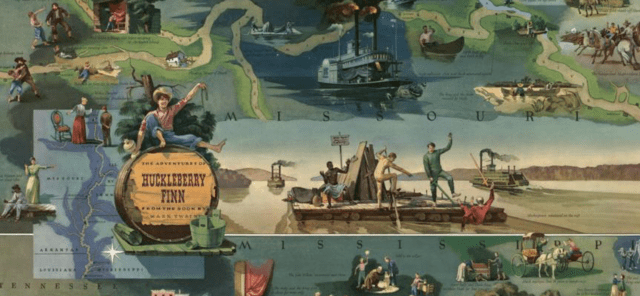
By Jay Innis Murray
I knew the trickster Ulysses just as early as I knew the wily rabbit of Negro American lore, and I could easily imagine myself a pint-sized Ulysses but hardly a rabbit, no matter how human and resourceful or Negro. And a little later I could imagine myself as Huck Finn (I so nicknamed my brother) but not, though I racially identified with him, as Nigger Jim, who struck me as a white man’s inadequate portrait of a slave.
Ralph Ellison
Being human is aspiring to be human. Since it is not aspiring to being the only human, it is an aspiration on behalf of others as well. Then we might say that being human is aspiring to being seen as human.
Stanley Cavell, The Claim of Reason
There are novels that are field work in philosophy. As conversations with the tradition of novels that came before them, they are deeper than exercises in style. These books might even throw the concern with style straight out the window. In several interviews this year in support of his newest book, James, the novelist Percival Everett said he did not write his book as a corrective of Huckleberry Finn. In Twain’s novel, Everett believes, the enslaved character Jim has agency. He runs for freedom after all, and, late in the book, he puts that freedom at risk to help the wounded Tom Sawyer who has treated him badly. What Jim lacks is expression, Everett says. That’s what he wanted to give to his version of the character in James. Since he succeeds in this, and since I’m a reader who likes to read a writer on their own terms, I have to wonder how modest Everett was in saying he didn’t write a corrective. We can charitably grant that it was not Twain’s mission to draw an adequate portrait of a slave (to use Ellison’s terms above). We can agree Twain wrote Huck’s book not Jim’s. Still, that kindness to the author only stretches so far. Recall Twain’s Explanatory note at the front and his painstaking work on the dialects. I take him at his word there. He painted a portrait, and one of the figures in it was not good enough.
In The Claim of Reason, Stanley Cavell writes of an ethical lack or a source of injustice he calls “soul blindness,” a concept that builds upon Wittgenstein’s term “aspect blindness” from The Philosophical Investigations. Wittgenstein describes a person “lacking in the capacity to see something as something.” If we think of the example of Jaslow’s rabbit-duck image, we all know the self-conscious feeling of seeing the ambiguous picture in both possible ways, one at a time, of course, but in both ways. When we see the rabbit or the duck, we are noticing an aspect of the image. We are seeing it as something. The aspect-blind person may be blind to an aspect of something because they don’t see the aspect as meaningful.
Cavell runs with this line of thinking and brilliantly applies it to ethics. Here is how he introduces the concept of soul blindness:
If it makes sense to speak of seeing human beings as human beings, then it makes sense to imagine that a human being may lack the capacity to see human beings as human beings. It would make sense to ask whether someone may be soul blind. (The Claim of Reason, page 378)
The previous three pages of Cavell’s book are a tour de force of writing about a person’s relation to others, using the slaveowner as an example of a person with the wrong internal relation to others vis-à-vis their own personhood. Here are some of his claims.
What [the slaveowner] believes is not that slaves are not human beings, but that some human beings are slaves… Since he has some, it follows that there are some. No, but this man sees certain human beings as slaves, takes them for slaves. He need not claim that all such persons ought to be in slavery, merely that it is all right if some are. (The Claim of Reason, page 375)
What [the slaveowner] is missing is not something about slaves exactly, and not exactly about human beings. He is rather missing something about himself, or rather something about his connection with these people, his internal relation with them, so to speak.
(The Claim of Reason, page 376)
[The slaveowner] means, indefinitely, that they are not purely human. He means, indefinitely, that there are kinds of humans. (The Claim of Reason, page 376)
To admit that the slaveowner regards the slave as a kind of human being bases slavery on nothing more than some indefinite claim of difference, some inexpressible ground of exclusion of others from our existence in our realm of justice. (The Claim of Reason, page 378)
Mark Twain had a strong intuition of how an entire society can be soul blind. In The Adventures of Huckleberry Finn, he does not sketch Cavell’s sort of argument in explicit philosophical terms, but he shows the blindness in the world. Consider Chapter 32 in which Huck lies to Aunt Sally and invents a story about an explosion on a steamboat he was taking from New Orleans.
‘It warn’t the grounding—that didn’t keep us back but a little. We blowed out a cylinder head.’
‘Good gracious! Anybody hurt?’
‘No’m. Killed a nigger.’
‘Well, it’s lucky; because sometimes people do get hurt…’
Here both Huck and Aunt Sally exclude the killed person from the categories of “anybody” or “people.” The killed person was a different kind of human being in Cavell’s slaveowner’s terms. It’s important to note for later that this conversation occurs after Huck’s celebrated decision to help rescue Jim from slavery in the previous chapter (Chapter 31).
We begin our approach to James with a seductive premise: a sequel to a classic novel, or a retelling from the perspective of a secondary character (sometimes the villain), or, at the very least, somebody other than the original narrator. In the case of Mark Twain’s The Adventures of Huckleberry Finn, there have been many subsequent books and stories that orbit like satellites around it. Percival Everett’s own good friend and Brown University mentor Robert Coover published Huck Out West in 2017, which picks up Huck’s story after he heads out for the Territory. In his 2015 book of stories, Counternarratives, John Keene has a story called “Rivers,” which is also a sequel to Twain’s novel, but this time it is told by Jim. It is enough to say that many of the Huck sequels are anything but cheap attempts to throw a tow line onto Twain’s raft. Major writers have experimented like Everett does. James was published this past March by Doubleday and is now longlisted for the Booker Prize and shortlisted for the National Book Award.
Everett’s novel is faithful to the shape of Twain’s, which I will assume is known. James follows the Mississippi River journey structure, but there is one major exception or what I’d call exorcism. Everett disappears the events of the final 12 chapters of Huck Finn and provides Jim with his own ending. This is one of his best moves. He mostly gets rid of Tom Sawyer. In a mock trial for crimes against good faith, the piles of evidence against Tom Sawyer would cause the prosecutor’s table to collapse. In Tom’s own book, Twain repeatedly shows Tom’s low moral character. He famously tricks Ben Rogers into completing his fence painting chore for him. He feeds the cat, Pete, a painkiller he himself does not want to take. He is thrilled to find Aunt Polly in despair and grief when he is missing and feared drowned. Worst of all, in his own book, he does not wish to be seen in public with Huck who is privately his friend. As Twain put it humorously, [Tom] was not the Model Boy of the village. He knew the model boy very well though—and loathed him.
Tom Sawyer’s acts in the last part of Huck Finn are grim, they are darker than in his own book, and they make for an ending that has disappointed some readers for decades, an ending that diminishes the greatness of Chapter 31 in which Huck recognizes the humanity in Jim and decides he’ll go to Hell if that is to be the consequence for helping free Jim after Jim has been sold back into slavery by the Duke and King. Tom dismisses Huck’s perfectly good plan to free Jim from the cabin he’s locked up in. ‘My plan is this,’ I says. ‘We can easy find out if it’s Jim in there. Then get up my canoe tomorrow night, and fetch my raft over from the island. Then the first dark night that comes, steal the key out of the old man’s britches, after he goes to bed, and shove off down the river on the raft, with Jim, hiding daytimes and running nights, the way me and Jim used to do before. Wouldn’t that plan work?’ (Huck Finn, Chapter 34). Of course, that plan would work. Tom admits it, but Twain and Tom have other plans. Twain wants to deliver an extended comic routine for the readers who loved Tom’s own book, and Jim is to be the butt of the jokes and stripped of the humanity so recently seen by Huck. Tom is a frivolous Quixote or Emma Bovary. He wants to delay Jim’s rescue as long as possible, so that Tom’s and Huck’s act of heroism will be more like the books he’s read, adventure novels in which it takes a prisoner years or decades to break out of their cell.
In a quarter of the novel that seems to go on forever, Jim is forced by Tom:
(a) to deny his own speech
(b) to delay clearing out of the cabin without losing any time (Jim’s desire)
(c) to agree the two boys who are playing with his life are “white folks and knowed better than him”
(d) to be the butt of minstrel character comedy when he bites into some corn bread Tom has shoved a piece of a candlestick into and almost “mashed all his teeth out”
(e) to talk like a minstrel character when he says he’ll bust through a wall with his head if a rattlesnake appears
(f) same thing with rats
(g) to acquiesce and shut down his own frustration, as the reader must, as things go on like this.
I’d forgotten how ridiculous it gets when Jim has to lie in bed with snakes and spiders. All of this for a few chuckles from his white readers, and Twain even has the audacity to have Jim praise the plan at the end. The opening of Everett’s novel dispatches the idea that the Jim we see in that last quarter of Huck Finn is the real man. He opens fiercely.
Those little bastards were hiding out there in the tall grass. The moon was not quite full, but bright, and it was behind them, so I could see them as plain as day, though it was deep night. Lightning bugs flashed against the black canvas. I waited at Miss Watson’s kitchen door, rocked a loose step board with my foot, knew she was going to tell me to fix it tomorrow. I was waiting there for her to give me a pan of corn bread that she had made with my Sadie’s recipe. Waiting is a big part of a slave’s life, waiting and waiting to wait some more. Waiting for demands. Waiting for food. Waiting for the end of days. Waiting for the just and deserved Christian reward at the end of it all.
Those white boys, Huck and Tom, watched me. They were always playing some kind of pretending game where I was either a villain or prey, but certainly their toy. (Chapter 1, page 9)
This brilliant start answers the long close of Huckleberry Finn, as Jim makes it obvious that he knows what is up. Likewise, we are quickly introduced to his voice. Rather than passive and clumsy, our narrator is intelligent, and, since he reads books, he knows how to construct paragraphs. He knows how to meet and dismantle discourses. He speaks with a biting irony. As pleasing as this is as a first move, it is something of a head fake, since the style of the novel does not go on like this, and the ironies are put to other uses. As I mentioned above, Everett erases Tom Sawyer from his book shortly after the opening.
The plot of James is driven by the same events as The Adventures of Huckleberry Finn. Jim’s life takes the same desperate turn. He escapes his slave bondage to Miss Watson after he finds out she has sold him to another slaveowner in far off New Orleans, and that he will be separated from his wife and daughter. Before the plot gets moving, however, we are taught the central irony of the novel, the dynamics of the “slave filter.” As Jim says, “Safe movement through the world depended on mastery of language, fluency.” When the slaves of Everett’s novel’s world are around white people, they speak in the cliched manner that Jim does in Twain’s novel, using what Twain calls in his Explanatory note “the Missouri Negro dialect.” The slaves call this manner of speaking the slave filter; they are essentially bilingual and can code-switch back and forth. Their true fluency with language is hidden from their masters. Jim says, “White folks expect us to sound a certain way and it can only help if we don’t disappoint them… the only ones who suffer when they are made to feel inferior is us.” The dynamic fills Jim’s run for freedom with moments of hilarity and thriller suspense as he strives to avoid slips that would give the entire language game away.
With this starting point, what kind of book has Everett given us? He has given us the man, James Golightly, as he declares to Huck he ought to be called, and his own story as he would tell it, as if, to use Toni Morrison’s terms, Jim had climbed out of the ill-made clown suit that cannot hide the man within to dash through the absurd US South of the 1840s. The novel is a sort of half of a double helix with Twain’s novel in that when Huck and James get separated during their river journey, we only get the story of one. In Twain’s book, it is Huck. In Everett’s, we get James. This is complicated by the fact that, with a Percival Everett novel (“Percival Everett has finally written his slavery novel,” the writer joked in an interview), the border line dividing narration that might be sincere from text that can be read as cynical mockery is faint indeed.
Two of the best episodes in James run back-to-back right at the midpoint of the book. As in the Twain novel, James and Huck encounter the King and the Duke, two ridiculous, white con men who sell Jim back into slavery. Chapter 26 opens with James telling of his new situation after the sale.
The three of them, [Duke and King and Huck], disappeared down the road and around a bend. The extreme brightness of the morning felt incongruous with all that had just transpired. Huck and I had been violently separated, an event that was inevitable, but it was, nonetheless, jarring and unreal. And I was now, temporarily or not, the possession of yet another white person. I didn’t know where my new owner lived, only that he possessed at least one other person, and that I was expected to make iron shoes and nail them onto horses. (Page 149)
James is left with another slave named Easter to do blacksmithing work, a kind of work he has never done. Everett is good at showing the laboring side of the enslaved person’s life, and the solidarity of the men and women. Here Easter has to talk James through how to do it. This is nicely done. Easter also shares some news with James.
“There was a lynching upriver,” Easter said.
“I’m sorry to hear that,” I said.
“Guess what it was for?”
I wasn’t going to guess and Easter didn’t expect me to. I raked my brow with my forearm and looked at him.
“A pencil.”
An ice-cold spear hit the back of my stomach. “A what?”
“A pencil. Can you believe that? A slave was accused of stealing a damn pencil and they hanged him dead for it. They didn’t even find the pencil on him. What’s a slave need a pencil for? Can you believe that?”
They didn’t find the pencil upriver, because James has it. Ten chapters earlier, he had used it to write, something he had wanted to do for a long time.
My name is James. I wish I could tell my story with a sense of history as much as industry. I was sold when I was born and then sold again. My mother’s mother was from someplace on the continent of Africa, I had been told or perhaps simply assumed. I cannot claim to any knowledge of that world or those people, whether my people were kings or beggars. I admire those who, at fives years of age, like Venture Smith, can remember the clans of their ancestors, their names and the movements of their families through the wrinkles, trenches and chasms of the slave trade. I can tell you that I am a man who is cognizant of his world, a man who has a family, who loves a family, who has been torn from his family, a man who can read and write, a man who will not let his story be self-related, but self-written.
With my pencil, I wrote myself into being.
(Chapter 16, page 93)
This is amusingly meta. The reference to Venture Smith’s A Narrative of the Life and Adventures of Venture, a Native of Africa: But Resident above Sixty Years in the United States of America, Related by Himself declares a tradition James is aware of yet wishes to distinguish himself from. His insistence on the self-written nature of his own work leaves no room for doubt about his own voice. There is little room for skepticism. No clown suits. There is no room for Mark Twain to tell the story, even one that is mostly a true book, as Huck would say. Of course, James is a fiction, and his story is being written by Everett, but that just adds another layer to the fun complexity. The death of Young George who had stolen the pencil and given it to James is one stop on a trail of death that James follows in the course of the novel (Pap, Young George, Sammy, Norman, Overseer Hopkins). These deaths would be fruitful for a reader to follow, as would be the moments when Huck wakes James from dreams or hallucinations and seems to try to pull James back into his (Huck’s) own novel.
Back now to Chapter 26. When Easter and James sing, as James works the hammer on the horseshoes, the singing is overheard by Daniel Decatur Emmett, the head of the Virginia Minstrels. Dan Emmett was a real figure most famous for composing the song “Dixie.” The Virginia Minstrels were a blackface troupe who were among the inventors of the minstrel show. Emmett is so impressed by James’ singing that he offers to buy James, and his offer is accepted. James joins the troupe, which has lost its tenor.
The next six chapters are the absurd heart of this novel for me. It is a true comedic gem. The troupe cannot have a real black man in its blackface show, so they have to apply makeup for James, so he will look like a white man in blackface. There is real risk involved, since if the real nature of the ruse were to be found out in some racist deep South town, James and the rest of the troupe could get lynched. I think this self-contained story within the novel gives life to Cavell’s argument about the soul-blind thinking that could allow slavery and minstrel shows to exist in the first place.
James feels it, too.
Never had a situation felt so absurd, surreal and ridiculous. And I had spent my life as a slave. There we were, twelve of us, marching down the main street that separated the free side of town from the slave side, ten white men in blackface, one black man passing for white and painted black, and me, a light-brown black man painted black in such a way as to appear like a white man trying to pass for black. The storefronts, a bank and a store and such, all looked flat and without depth, like I could just kick them over. It occurred to me that there was no telling which side was free and which was slave. Then I understood that it really didn’t matter. We marched in step, then fell into a cakewalk stagger. (Chapter 30, page 170)
This story ends Part One of the novel. The pacing of the book is uneven. In the second half, the plot accelerates toward an ending with the tone and thrilling violence of Tarantino’s Django Unchained. I think that ending is ethically serious and earned, but, at times, the second half of the novel feels like the sketches for a longer book. The majority of the philosophical themes are taken up in the first half. We’re left with much to think about regarding Mark Twain’s novel. Everett says he read it 15 times consecutively as he prepared and wrote James. Strangely enough, outside of the opening I quoted above, Everett’s own style does not strive for the comic inventiveness of Twain’s. I see that more in the John Keene story in which Jim confronts Huck and Tom as adults, and, ultimately, considers Huck from behind a pointed rifle on opposite sides of the Civil War.


 Talking Big
Leave a comment